

From Agent Architect to Agentic DevOps: Scaling the Unscalable
You’ve hired the builders. Now, you need the operational nervous system to support their creations.

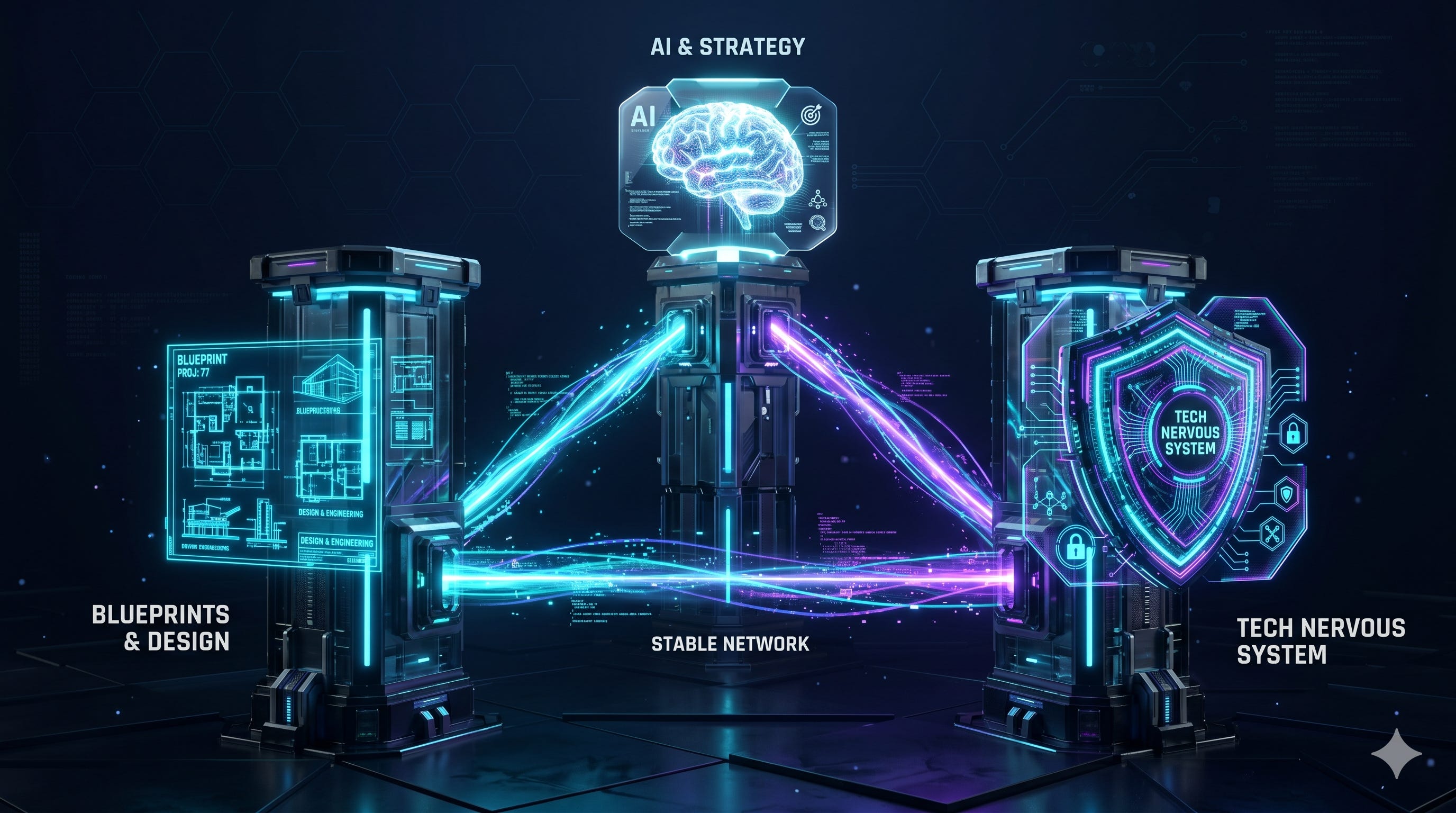
A few months ago, I wrote about the rise of The Agent Architect—the new engineering discipline required to bridge the gap between foundational LLMs and autonomous business logic.
Many of you agreed. The industry listened. Forward-thinking companies rushed to hire or upskill these architects, and we saw a massive explosion of brilliant, highly capable AI agents built in sandbox environments.
But now, those teams are hitting the deployment wall.
You have the Agent Architects. You have the agents. But how do you scale them across an enterprise without breaking your infrastructure?
To scale the unscalable, we need to understand that the modern engineering organization has evolved into a new triad:
The New Engineering Triad
The LLM (The Brain): The raw, probabilistic reasoning engine provided by OpenAI, Anthropic, or open-source models.
The Agent Architect (The Builder): The human engineer who contextualizes the brain, giving it tools, RAG pipelines, and business objectives.
Agentic DevOps (The Nervous System): The missing layer. The enterprise infrastructure that monitors, throttles, and ensures the brain and the builder don’t accidentally bring down production.
Without the nervous system, your agents are just isolated science projects.
If you are a CTO or VP of Engineering preparing to push autonomous agents into production this year, your legacy infrastructure is likely unprepared. Here is a 3-point audit to test your readiness for Agent-First Deployment:
The CTO’s Agentic Readiness Audit
1. Do you have dynamic “Blast Radiuses”? Traditional RBAC (Role-Based Access Control) assumes a user is human. If an agent goes rogue, how long does it take your system to automatically revoke its API keys? If the answer is “until a human notices the spike in Datadog,” you are not ready. You need autonomous circuit breakers.
🚨 The Nightmare Scenario: A customer success agent hallucinates a new refund policy and autonomously issues $500 credits to every user submitting a ticket via your Stripe API. Without dynamic blast radiuses, it drains $50,000 in 12 minutes before your on-call engineer even wakes up to check the alert.
2. Can you trace the “Why”? If a microservice fails, you check the stack trace. If an agent makes a disastrous business decision, a stack trace is useless. Can your current observability tools trace the probabilistic reasoning and memory state of an agent from 15 steps ago to explain why it took an action?
🚨 The Nightmare Scenario: Your automated data-enrichment agent starts systematically deleting active CRM records because it probabilistically determined that a missing field meant “duplicate.” Your engineering team spends two weeks manually reading raw LLM logs, but without memory state tracing, they have no idea what triggered the hallucination, meaning they can’t confidently patch it.
3. Are you managing Token-to-Outcome Efficiency? Standard cloud costs are predictable. Agentic API costs are volatile. Do you have infrastructure that automatically halts an agent if its token consumption exceeds the projected ROI of the task it is trying to complete?
🚨 The Nightmare Scenario: A background research agent gets caught in a recursive loop trying to parse a corrupted PDF. Because it has no cost-awareness guardrails, it burns through 50 million tokens overnight—costing you hundreds of dollars for a task that was only supposed to save a sales rep 10 minutes of manual work.
Building the Nervous System
If you failed this audit, you are not alone. The tooling simply hasn’t existed—until now.
Agentic DevOps is the necessary evolution to bring order to autonomous systems. We need an infrastructure layer that understands intent, manages state, and provides real-time, explainable guardrails.
This is exactly what we are building at Flurit.ai.
We are developing the enterprise-grade nervous system to make Agentic DevOps a reality, allowing your Agent Architects to deploy with absolute confidence.
You built the agents. Now, let’s scale them.