

Knowledge Base vs Knowledge Graph: What Production AI Agents Actually Need
A practical comparison of document retrieval and relationship-aware context—and why neither captures live production state on its own.

Founder’s note: I’m building Flurit, so I look at this comparison through a production-engineering lens. The question is not which architecture produces better chatbot answers. It is which one gives an agent enough context to reason safely about infrastructure, delivery, and runtime systems.
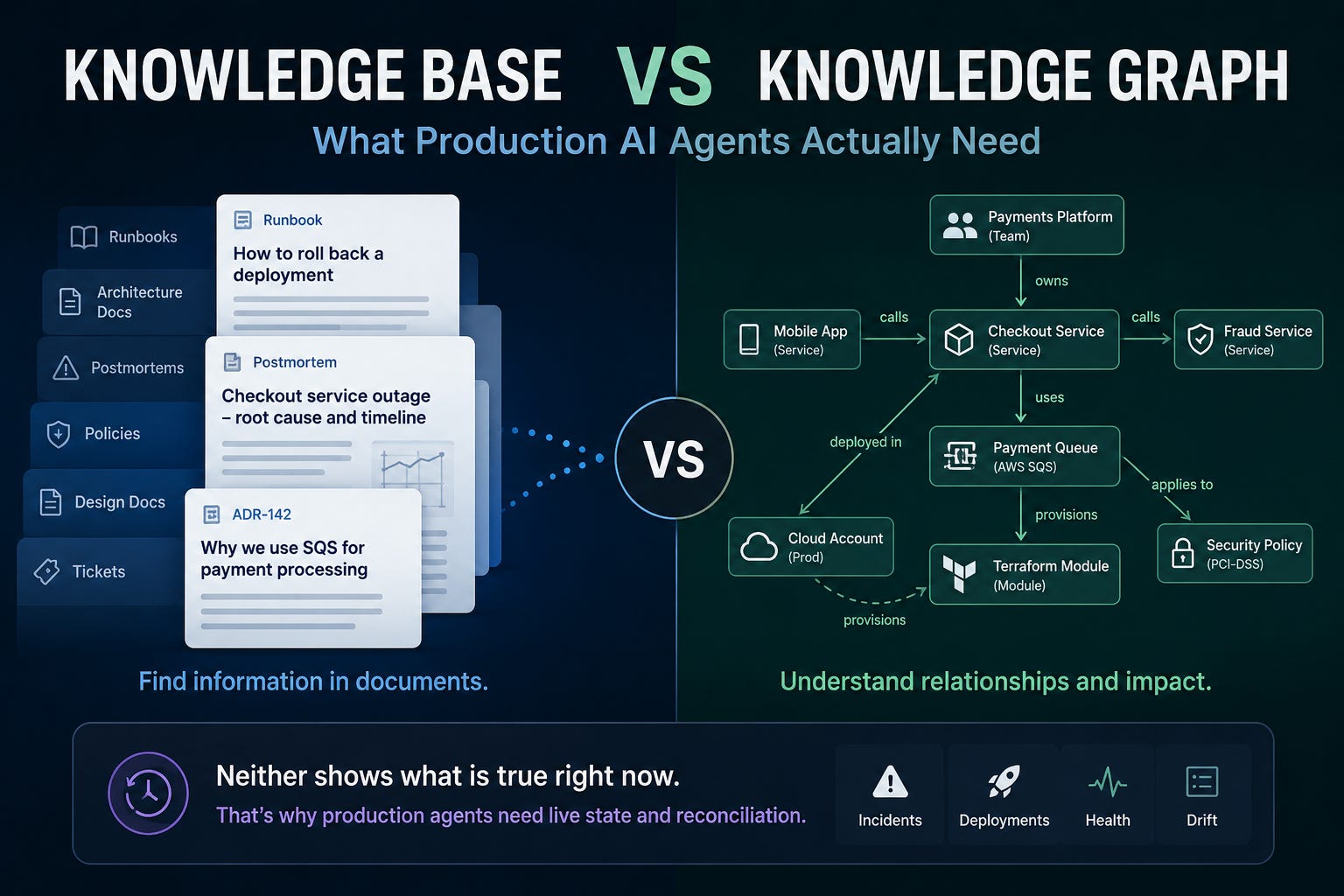
One Production Question Exposes the Difference
Imagine asking an AI agent a seemingly simple question:
Can I safely modify this Terraform module?
A knowledge base might retrieve the module documentation, the relevant architecture decision record, an infrastructure runbook, two postmortems, and the company’s IAM policy.
That gives the agent useful explanation.
A knowledge graph might identify that the module provisions a production queue, the queue supports a payment worker, the worker belongs to the Payments Platform team, the service participates in the checkout journey, and a security policy applies to the target cloud account.
That gives the agent useful relationships.
But neither system necessarily knows that an SRE changed the queue policy 40 minutes ago during an active incident.
That requires current operational state.
This single example captures the context problem facing production AI agents.
A knowledge base can tell the agent what the organization has documented. A knowledge graph can show how the relevant entities are connected. Live state can tell the agent what is actually true now.
These are different forms of context.
They solve different problems.
And as AI agents move from answering questions to proposing code, modifying infrastructure, routing reviews, assisting with incidents, and recommending production actions, confusing these layers becomes increasingly dangerous.
The debate is often framed as knowledge base versus knowledge graph, as though engineering teams must choose one and abandon the other.
That is the wrong framing.
The useful question is:
Which questions should each architecture answer, and where does each one fail?
That is what this post will unpack.
First, Define the Terms
The term “knowledge base” is overloaded.
Some vendors use it as a broad label for almost any external information system connected to an AI application. Under that definition, a knowledge graph could itself be part of a knowledge base.
That makes comparison difficult.
For this essay, I will use a narrower and more operational distinction.
A knowledge base is a document- or record-oriented context layer. It stores and retrieves information from sources such as architecture documents, runbooks, postmortems, policies, product specifications, tickets, wikis, and support records. Retrieval might use keyword search, semantic search, hybrid search, SQL, filters, reranking, or a RAG pipeline.
A knowledge graph is a relationship-oriented context layer. It represents real entities and the explicit, typed relationships between them. Instead of only storing a document that says Team Payments owns Checkout Service, it models that relationship directly:
Team Payments → owns → Checkout Service
This distinction is not absolute. Modern retrieval products increasingly combine structured data, documents, graph traversal, query decomposition, and multi-step retrieval.
But the distinction remains useful because the two architectures have different natural strengths.
A knowledge base is optimized for retrieving what has been said.
A knowledge graph is optimized for traversing what is connected.
Production agents eventually need both.
What a Knowledge Base Is Good At
A knowledge base is usually the fastest way to give an agent access to organizational knowledge.
Engineering organizations already produce enormous amounts of useful text: architecture decision records, platform documentation, operational runbooks, postmortems, security policies, onboarding guides, incident timelines, deployment procedures, service manuals, tickets, design documents, and internal standards.
A document-oriented knowledge base can ingest those sources, index them, and retrieve the material most relevant to a question.
That makes it particularly good at explanatory queries.
An agent can ask:
Why was this architecture chosen?
What is the approved procedure for rotating this credential?
How do we recover this service after a regional failure?
What did the last incident teach us?
Which security standard applies to customer data?
How is this Terraform module supposed to be used?
The knowledge base can find the relevant text and return it with citations.
That last part matters. Production engineering often requires provenance. A human reviewer needs to know whether an answer came from an approved policy, an outdated design document, an informal wiki page, or a postmortem written three years ago.
Knowledge bases are also relatively forgiving about input structure. Teams do not need to model every concept and relationship before they can begin. Existing documents can be indexed, chunked, embedded, filtered, and retrieved with limited upfront schema work.
That makes a knowledge base a sensible first context layer for many AI systems.
But its flexibility creates its main weakness.
The relationships are often implicit inside the text.
A runbook might say that Checkout Service depends on Risk Service, but the retrieval system may not treat that dependency as an explicit, traversable fact. A postmortem may mention that a queue supports a payment worker, but the relationship is buried inside a paragraph. An architecture document may identify the owning team, but the ownership information can become outdated without anyone updating the document.
A knowledge base can retrieve the right document and still miss the right impact path.
That is the limitation production engineering agents eventually hit.
What a Knowledge Graph Is Good At
A knowledge graph begins with a different assumption:
The relationships are part of the knowledge.
Instead of treating the engineering system as a collection of documents, it represents services, APIs, teams, environments, cloud resources, policies, incidents, deployments, SLOs, and customer journeys as entities connected by explicit relationships.
A small part of the graph might look like this:
Terraform Module → provisions → Queue
Queue → supports → Payment Worker
Payment Worker → belongs to → Checkout Service
Checkout Service → owned by → Payments Platform
Checkout Service → supports → Enterprise Checkout
Security Policy → applies to → Production Account
This representation supports a different class of question.
Instead of asking only, “What does the documentation say about this module?” the agent can ask:
Which services depend on the resources this module provisions?
Which team owns the operational consequences?
Which customer journeys could be affected?
Which policies apply to the target environment?
Which incidents involved the same dependency?
What is the shortest path from this infrastructure resource to a customer-facing service?
Who should review a proposed change?
These are relationship queries.
They require traversal.
The value is not simply that the graph stores more facts. The value comes from making the impact paths explicit.
This is why knowledge graphs are powerful for ownership resolution, dependency analysis, blast-radius estimation, policy applicability, provenance, and multi-hop reasoning.
They are also easier to inspect. If an agent claims that a Terraform change affects the checkout flow, a human can examine the path through the graph and ask whether each relationship is authoritative.
But knowledge graphs carry their own cost.
The organization has to decide what the entities are, which relationships matter, how identities are resolved across systems, who owns the schema, and how the graph stays current.
A graph built from stale catalog entries and outdated architecture documents does not create intelligence. It creates structured misinformation.
The second limitation is narrative depth. A graph may show that a service was involved in an incident, but it may not explain the sequence of decisions, contributing factors, and operational lessons captured in the postmortem.
The graph exposes the relationship.
The knowledge base preserves the explanation.
That is why one does not cleanly replace the other.
Knowledge Base vs Knowledge Graph
The difference becomes clearer when we compare the two architectures by the questions they are naturally designed to answer.
What does each architecture represent?
A knowledge base represents information. Its natural units are documents, passages, records, policies, tickets, runbooks, postmortems, and design decisions.
A knowledge graph represents entities and relationships. Its natural units are services, teams, APIs, resources, environments, policies, incidents, and the explicit connections between them.
A knowledge base might store a document explaining who owns Checkout Service. A knowledge graph models the relationship directly:
Payments Platform → owns → Checkout Service
What question is each one best at answering?
A knowledge base is strongest when the agent asks:
What does the organization know about this?
It can retrieve the relevant architecture decision, operational procedure, policy, or incident report and explain it in natural language.
A knowledge graph is strongest when the agent asks:
How is this connected, and what else could be affected?
It can traverse ownership, dependencies, infrastructure relationships, policy boundaries, and customer-impact paths.
Where does the context come from?
A knowledge base usually draws from runbooks, wikis, architecture documents, tickets, postmortems, standards, product specifications, and other written records.
A knowledge graph usually draws from service catalogs, cloud inventories, CMDBs, API catalogs, dependency maps, ownership systems, deployment metadata, and observability platforms.
Documents preserve explanation.
Graphs preserve structure.
What is the main strength?
The strength of a knowledge base is flexibility. Teams can ingest existing information without first designing a detailed model of the entire organization. It is well suited to semantic search, question answering, procedural guidance, and historical explanation.
The strength of a knowledge graph is explicit context. It can reveal multi-hop relationships that may be scattered across dozens of documents or absent from them entirely.
A knowledge base can explain why a service was designed a certain way.
A knowledge graph can reveal every service, team, environment, and policy connected to it.
Where does each one fail?
A knowledge base can retrieve the right document and still miss the broader impact path. Relationships often remain buried inside prose, duplicated across sources, or implied rather than explicitly represented.
A knowledge graph can expose the right relationship and still lack the explanation behind it. It may show that a service was involved in an incident without capturing the reasoning, tradeoffs, and lessons documented in the postmortem.
The knowledge base may know the story but miss the structure.
The knowledge graph may know the structure but miss the story.
What does maintenance look like?
A knowledge base is relatively easy to start but difficult to keep authoritative. Old runbooks, conflicting documents, weak metadata, and missing permissions can quietly degrade retrieval quality.
A knowledge graph requires more modeling effort upfront. Teams must resolve identities, define relationships, establish authoritative sources, and keep the graph synchronized as ownership and dependencies change.
Neither architecture escapes the freshness problem.
They simply experience it differently.
What is the production limitation?
A knowledge base may describe yesterday’s system.
A knowledge graph may model yesterday’s relationships.
Neither necessarily knows that a rollout is paused, a dependency is degraded, an incident is active, or an SRE applied a temporary mitigation forty minutes ago.
That is why production agents need a third layer: live state.
The knowledge base tells the agent what has been documented.
The knowledge graph tells it how the system is connected.
Live state tells it what is true now.
The comparison does not produce a winner. It produces an architecture. Production AI agents usually need the knowledge graph to identify the relevant entities and relationships, the knowledge base to retrieve the supporting evidence and explanation, and live state to determine whether that information still reflects current reality.
A Knowledge Graph Is Not the Same as GraphRAG
This distinction is especially important for readers familiar with RAG and GraphRAG.
A knowledge graph is a data model. It represents entities, properties, semantics, and relationships.
GraphRAG is a retrieval pattern. It uses graph structures to improve how context is selected and assembled for a model. Depending on the implementation, the graph might be extracted from documents, built from authoritative systems, or created through a combination of methods.
GraphRAG can make document retrieval more relationship-aware. It can help answer questions that require multi-hop evidence, causal chains, entity relationships, or broader understanding of a corpus.
But an LLM-derived graph built from documents is not automatically an authoritative operational model.
That distinction matters in engineering.
If an architecture document says Team A owns a service, but the service catalog says Team B owns it now, the agent should not treat both sources as equally authoritative.
If an old postmortem says Service X depends on Database Y, but the runtime topology shows the dependency was removed six months ago, the graph should reflect the current system.
If a language model infers that two services are related because they are frequently mentioned together, that is not the same as a dependency observed through traces, service metadata, deployment configuration, or an API catalog.
For production agents, relationship truth should come from authoritative engineering systems whenever possible.
Documents can enrich the graph.
They should not be the only source of it.
This is where the Platform Graph becomes more specific than a generic knowledge graph.
A Platform Graph is an operational knowledge graph for the engineering system. It connects services, teams, repositories, infrastructure, environments, policies, deployments, incidents, SLOs, and runtime signals.
Its purpose is not simply to improve question answering.
Its purpose is to ground engineering decisions.
Production Agents Usually Need Both
Return to the original question:
Can I safely modify this Terraform module?
A production-grade agent should not answer that question from a single retrieval system.
First, it needs to resolve what the module represents. Which cloud resources does it provision? Which services use those resources? Which team owns them? Which policies apply? That is graph work.
Once those entities are known, the agent needs the relevant explanation. Why was the module designed this way? What is the approved change procedure? Which previous incidents involved these resources? What does the security standard require? That is knowledge-base work.
The graph narrows the search space.
The knowledge base supplies the narrative and procedural context.
This creates a useful hybrid pattern:
Graph-guided retrieval over an authoritative knowledge base.
Instead of performing a broad semantic search across every document, the system can use the graph to identify relevant services, owners, policies, incidents, and infrastructure resources. It can then retrieve the runbooks, design records, postmortems, and standards attached to those entities.
This improves both precision and explainability.
The agent does not retrieve a document merely because its wording resembles the query. It retrieves the document because it belongs to an entity or relationship that is relevant to the change.
The same architecture helps with review routing. The graph identifies the affected services and owners. The knowledge base retrieves the policies and review standards that explain why those people need to be involved.
It also helps with incident investigation. The graph identifies the dependency path between a recent deployment and a failing customer journey. The knowledge base retrieves similar postmortems and recovery procedures.
This is where the knowledge base and knowledge graph stop competing.
They become complementary layers.
But production still introduces one more problem.
Both layers can be correct and still be out of date.
The Missing Third Layer: Live State
A knowledge base can explain the system.
A knowledge graph can model the system.
Neither necessarily tells the agent what is happening right now.
That requires live state.
The documentation may say a rollout proceeds automatically after staging. The rollout may currently be paused.
The graph may say the production queue is governed by a standard policy. An SRE may have applied a temporary restriction during an incident.
The service catalog may show the normal service owner. A separate incident team may currently own production decisions.
The architecture record may say a service calls a dependency synchronously. Traffic may have been temporarily routed around that dependency.
The graph can represent the relationship accurately while still missing its current operational condition.
This is why the recent State Reconciliation discussion matters.
Production context is temporal.
It includes active incidents, current deployments, manual mitigations, runtime health, drift, feature-flag exposure, error-budget consumption, degraded dependencies, maintenance windows, policy exceptions, and human decisions made under pressure.
A production agent therefore needs three forms of context:
Descriptive knowledge: What has the organization documented?
Relational knowledge: How is the engineering system connected?
Temporal truth: What is actually true now?
This is also why a Platform Graph should eventually become more than a static graph of catalog metadata.
It should be enriched by deployment events, runtime signals, state changes, incident status, policy updates, and operational deltas.
A static knowledge graph can tell an agent that Service A depends on Database B.
A live Platform Graph can also tell the agent that Database B is degraded, a migration is in progress, and a rollback mitigation is active.
That changes the decision.
The Production Context Stack
The architecture production agents need is not one giant memory store.
It is a context stack.
At the bottom of the stack is the knowledge base. It preserves documents, explanations, procedures, historical decisions, policies, and operational narratives.
Above that is the knowledge graph. It turns entities and relationships into a navigable model of the engineering system.
For engineering-specific use cases, that graph evolves into a Platform Graph enriched with services, ownership, infrastructure, deployments, incidents, SLOs, policies, and environment metadata.
The next layer is live state. This brings in current infrastructure state, active rollouts, telemetry, incidents, mitigations, drift, and operational conditions.
Finally, the delivery system needs a reasoning layer. It uses the combined context to perform change-impact analysis, evaluate policies, route reviews, recommend rollout strategy, or block unsafe action.
The flow looks like this:
Proposed task or change
→ resolve affected entities
→ traverse relationships
→ retrieve relevant documents
→ reconcile current state
→ evaluate impact and policy
→ route to the next control point
This is the architecture that separates a general enterprise assistant from a production-aware engineering agent.
The assistant answers questions from company information.
The production agent reasons over the engineering system before participating in change.
That is a much higher bar.
A Concrete Example
Suppose an agent is asked to increase the throughput of a payment worker by changing its queue and autoscaling configuration.
A knowledge-base-only system might retrieve the worker documentation, the scaling runbook, the queue configuration guide, and a previous performance incident. It could produce a plausible plan.
But it might miss that the worker shares a downstream database with another service.
A knowledge graph could reveal that dependency. It could identify the database, its owner, the affected customer journey, and the policy requiring database-team review.
But it might still miss that the database is currently consuming most of its connection capacity.
Live state reveals that condition.
The combined system can now produce a very different response:
The proposed worker scaling change could increase concurrency against Customer Ledger Database. The database currently operates at 82% connection utilization and is consuming error budget after a latency event earlier today. Payments Platform owns the worker; Ledger Infrastructure owns the database. The scaling runbook recommends staged increases above 20%. Recommendation: defer automatic application, route for Ledger Infrastructure review, and validate against database connection saturation in staging.
That is not a better chatbot answer.
It is a better engineering decision.
The knowledge base supplied the runbook.
The graph exposed the dependency and ownership path.
Live state changed the recommendation.
That is what production context architecture is supposed to do.
When to Use Which Architecture
Start with a knowledge base when the primary problem is finding and explaining information.
If engineers cannot locate runbooks, policies, design decisions, postmortems, or platform documentation, a graph will not fix the underlying information-access problem. Build reliable ingestion, metadata, permissions, retrieval, citations, and evaluation first.
Add a knowledge graph when the important questions become relational.
If the agent needs to understand ownership, multi-service dependencies, policy applicability, provenance, customer-impact paths, or blast radius, document retrieval alone becomes increasingly fragile.
Add live state before the agent is allowed to influence production decisions.
Once an agent can propose infrastructure changes, route deployments, assist with incidents, modify configuration, or recommend remediation, static knowledge is no longer enough. The system must know whether the environment is healthy, drifted, degraded, under mitigation, or actively changing.
Use the hybrid architecture when the agent must both explain and reason.
That will be the common case for production engineering.
A knowledge base without a graph can retrieve rich context but miss relationships.
A knowledge graph without a knowledge base can expose relationships but lose the explanation behind them.
Both without live state can make a perfectly informed decision about yesterday’s system.
The Key Takeaway
Do not ask whether a knowledge base or knowledge graph is universally better. Start with the query shape. Use a knowledge base for documents, procedures, policies, and historical explanation. Add a knowledge graph when the agent needs ownership, dependencies, provenance, and multi-hop impact paths.
Use the graph to guide retrieval, not replace it. The graph should identify the relevant services, owners, infrastructure, policies, and incidents. The knowledge base should provide the documents and evidence that explain those relationships and constrain the decision.
Add live state before scaling production autonomy. Documentation describes the system, and a graph models its relationships. Production agents also need current runtime health, drift, active rollouts, incidents, mitigations, and policy exceptions before they can safely influence change.
The broader lesson is that production agents do not need one giant bucket of context.
They need different context architectures for different questions.
The knowledge base tells the agent what the organization knows.
The knowledge graph tells it how the system is connected.
Live state tells it what is true now.
Only when those layers work together can an AI agent begin to reason about production rather than merely talk about it.