

The Agent Stack is the New Cloud Stack
A 7-layer framework for scaling autonomous swarms with security, memory, and fiscal control.

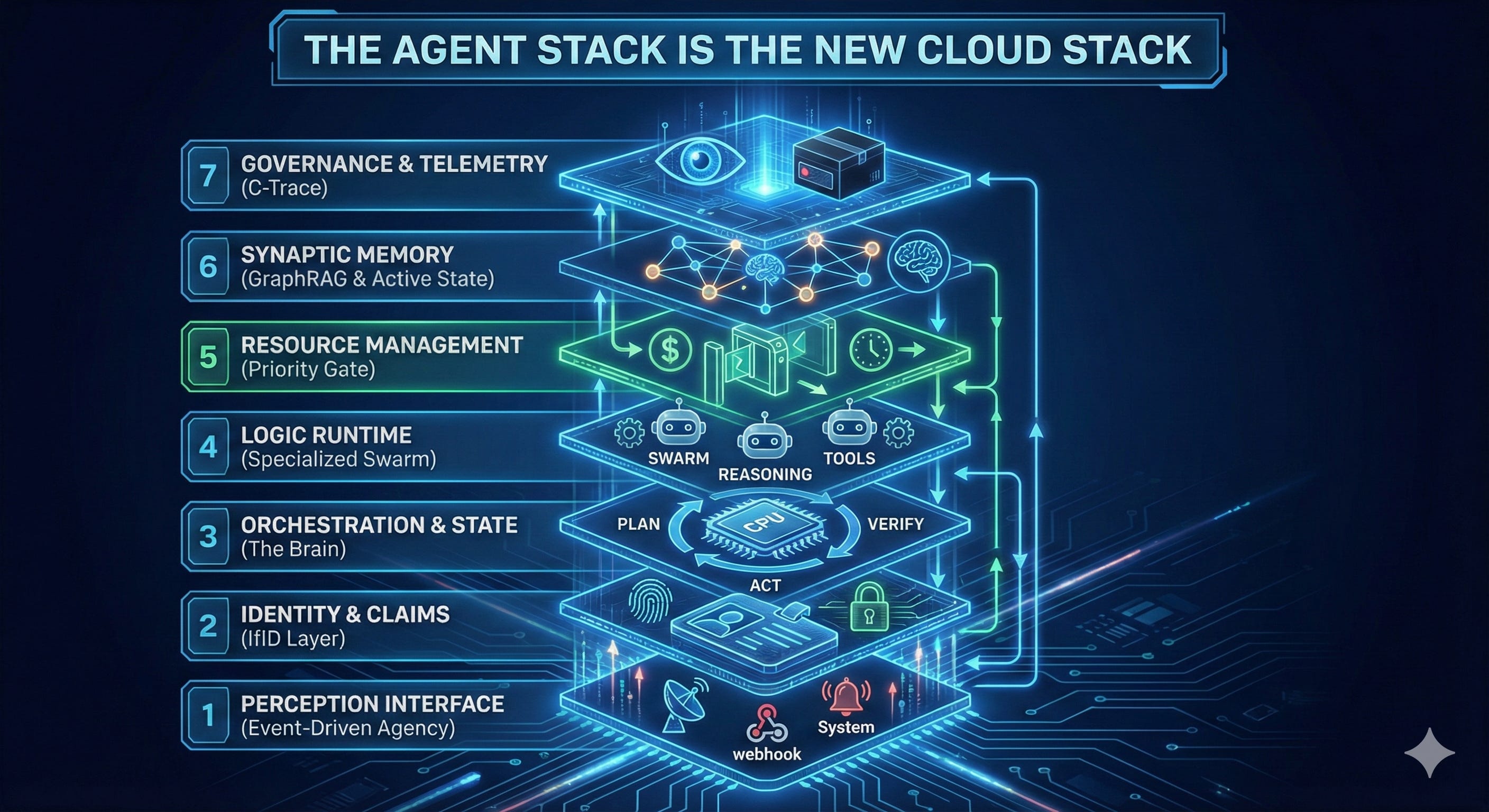
In 2012, being a “Cloud Engineer” meant more than just knowing how to launch an EC2 instance. It meant understanding the Stack: how S3 handled persistence, how IAM governed identity, and how VPCs secured the perimeter.
It is now 2026, and we are at the same crossroads with Agentic AI.
The industry is currently obsessed with “Prompts” and “Models,” but as I’ve argued before, overloading context in a single-prompt monolith is a recipe for failure. To build for the enterprise, we have to stop thinking about “LLM Apps” and start building Layered Agent Stacks.
If you don’t design your stack intentionally, your system won’t just hallucinate—it will collapse under the weight of its own complexity and cost.
Part 1: The 7 Layers of the Autonomous Stack
In my previous posts, we’ve explored the individual pillars of an “Authentic” agent. When we assemble them, we get a production-grade architecture that looks less like a chatbot and more like a distributed system.
Layer 1: The Perception Interface (Event-Driven Agency) Agents are moving from “Chat-first” to “Event-first.” Whether it’s a GitHub webhook or a system alert, the perception layer is where the agent “wakes up.”
Layer 2: Identity & Claims (The IfID Layer) You cannot have autonomy without accountability. As we discussed in Beyond the API Key, every agent needs an Internal Federated Identity (IfID). We don’t give agents master keys; we give them scoped, verifiable claims.
Layer 3: Orchestration & State (The “Brain”) This is the domain of tools like LangGraph or the Claude Agent SDK. It manages the loop: Plan → Act → Verify. This layer ensures the agent doesn’t just “talk”—it executes a state machine.
Layer 4: The Logic Runtime (The Specialized Swarm) Instead of one big model, we deploy a specialized swarm. Why? Because 3 small agents consistently beat 1 big model in both reliability and specialized reasoning.
Layer 5: Resource Management (The Priority Gate) Sitting between Orchestration and Logic is the Priority Gate. This layer manages the “Cost of Thought,” ensuring high-reasoning tokens are reserved for critical failures, while local models handle formatting.
Layer 6: Synaptic Memory (GraphRAG & Active State) See the deep dive below.
Layer 7: Governance & Telemetry (The C-Trace Layer) The “Flight Recorder.” C-Trace provides the granular observability required for humans to audit exactly why an agent reached a conclusion.
Part 2: Deep Dive into Layer 6 — The Synaptic State
We need to move beyond “Passive RAG.” In a traditional RAG setup, an agent looks for text that looks like the question. This is fine for FAQs, but it’s useless for Complex Agency.
In 2026, the leading edge of architecture is the Synaptic State, powered by GraphRAG.
Why Vectors are the “Short-Term Memory” of AI
Vector databases are excellent at Similarity, but they are blind to Structure. If you ask an agent, “What was the root cause of the last three deployment failures?”, a vector search will give you three similar-looking logs. It won’t tell you that they all share a single DEPENDS_ON relationship with a legacy database.
The GraphRAG Advantage: Persistence over Time
By using a Knowledge Graph as the agent’s “Synaptic Memory,” we allow the agent to:
Traverse Multi-hop Relationships: It can connect a “User Complaint” (Node A) to a “Latency Metric” (Node B) to a “Recent Commit” (Node C).
Implement “Sleep Cycles”: Just as humans consolidate memory during sleep, a mature agent stack runs background processes that scan the day’s C-Trace logs, extract new entities/relationships, and update the Graph.
State Resilience: If an agent “dies” mid-task, the next agent doesn’t just read the history; it queries the Graph to understand the current world state and picks up exactly where the last one left off.
Part 3: The Battle for Control (Copilot vs. Claude SDK)
With the launch of OpenAI Frontier and the competing SDKs from Anthropic and GitHub, the big question isn’t “which model is smarter?” It’s “Who controls the execution environment?”
GitHub’s Copilot SDK is optimized for Layer 1 and 3: deeply integrated into the developer runtime. It’s about Convenience.
Claude’s Agent SDK is optimized for Layer 4: model-centric autonomy. It’s about Intelligence.
For the Agent Architect, the choice is about vendor lock-in. If you build your Identity (IfID) and Priority Gates natively into your stack, the SDK becomes a swappable component rather than a permanent cage.
The Verdict
The “Agent Stack” is the only way to move from a weekend demo to a multi-million dollar production swarm.
IfID secures the “Who.”
C-Trace records the “Why.”
The Priority Gate ensures the “ROI.”
Synaptic State ensures the “Growth.”
Are you building a stack, or are you just wrapping a prompt? Let’s talk about your “Layer 6” memory strategies in the comments.
This is a pretty solid structure for approaching agentic systems. I need to figure out how to tailor this to my nl2sql solution for ERP systems
Thank you, Sumant! 🤝