

The Missing Layer Between AI-Generated Code and Production
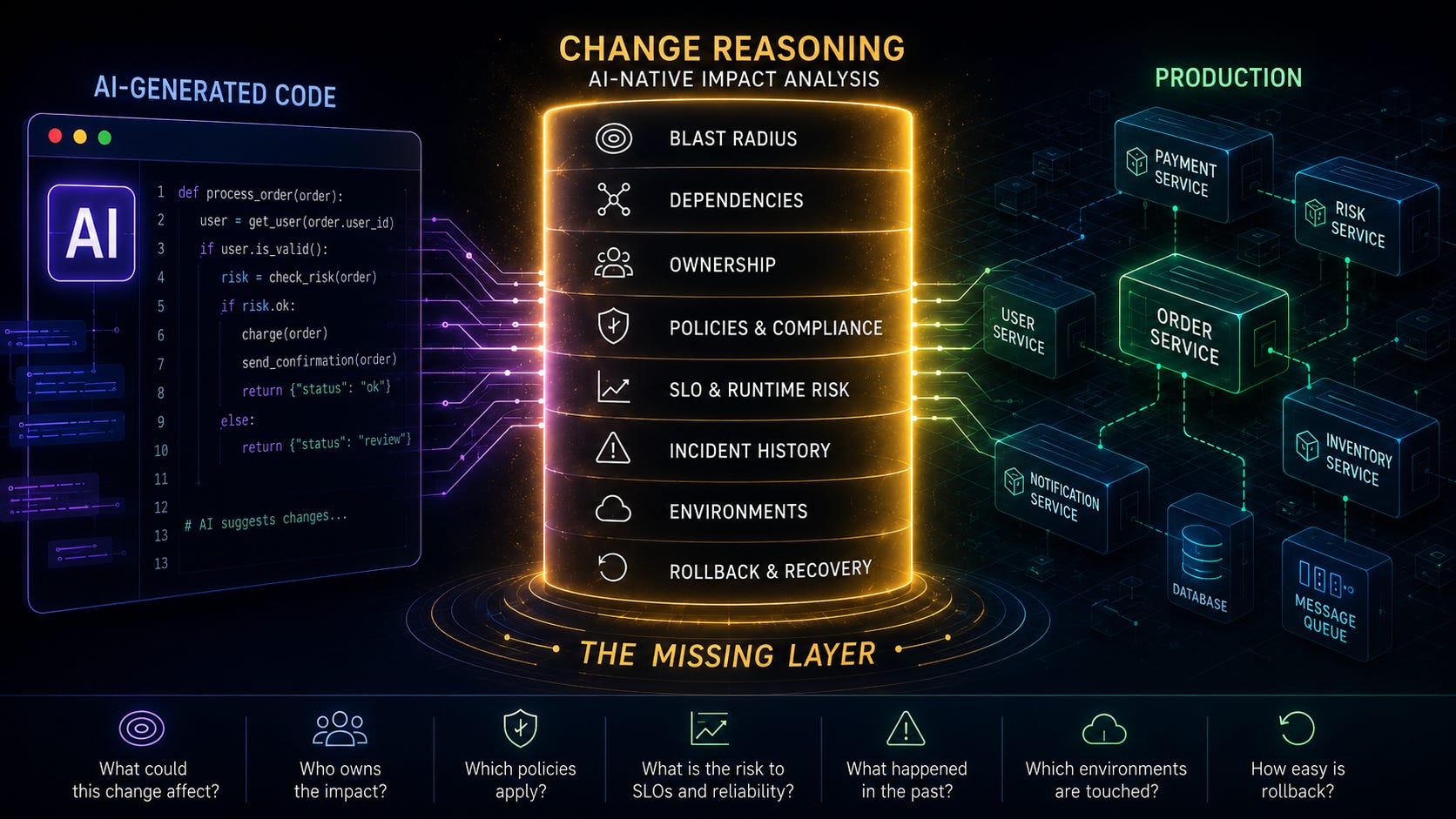
The Platform Graph gives agents a system map. Change Reasoning turns that map into impact analysis before production.

Founder’s note:
This post comes from the architecture problem behind Flurit: AI can generate infrastructure changes faster than teams can safely trust them. The hard part is not producing a Terraform diff. The hard part is knowing whether that diff is safe against actual production state, drift, active mitigations, policy exceptions, runtime pressure, and recovery risk.
The Diff Is Not the Change
The diff is not the change.
The diff is only the artifact our tools know how to show us.
The real change is what that diff does to the system.
A pull request can show which files changed, which functions moved, which Terraform resource was updated, which Helm value changed, or which dependency was added. But it cannot, by itself, explain the full production consequence of that change.
It cannot tell you whether a downstream service is now exposed to more latency. It cannot tell you whether a policy boundary has shifted. It cannot tell you whether a service owner has inherited new operational risk. It cannot tell you whether an SLO is now harder to meet. It cannot tell you whether rollback is still safe.
That hidden layer is where agentic DevOps gets interesting.
In the previous essay, I wrote about the

Platform Graph: a live map of services, dependencies, ownership, infrastructure, policies, incidents, SLOs, deployment history, and runtime state.
That map matters because repository context is not enough for AI agents. A coding agent can inspect files, follow imports, run tests, generate patches, and open pull requests. But the repository is not the system. The system includes the platform around the repository: services, teams, dependencies, environments, infrastructure, runtime behavior, incidents, policies, and production state.
But a map is only step one.
The next question is whether agents can reason over that map before a change moves forward.
That is what I call Change Reasoning.
Change Reasoning is AI-native change impact analysis. It is the ability to evaluate a proposed code, infrastructure, configuration, dependency, or deployment change against the live platform model before that change reaches the next control point.
That control point might be pull request review. It might be CI promotion. It might be staging. It might be production rollout. It might be an incident mitigation step. It might be an automated fix-forward path.
The point is not that an agent should make every decision. In many cases, it absolutely should not.
The point is that the hidden impact of a change should become visible before humans, pipelines, or automated controls decide what happens next.
A Platform Graph tells the agent where things are connected.
Change Reasoning helps the agent ask what happens if one of those things changes.
That is the next layer of agentic DevOps.
Why Repository-Native Agents Are Not Enough
The first wave of coding agents has been repository-native. That is natural. Most software work starts in the repository, and the repo gives the agent a structured implementation surface: functions, modules, interfaces, test files, infrastructure code, dependency manifests, and local documentation.
For local implementation, that context can be enough. If the task is to update a small function, add a unit test, fix a typo, or refactor a contained module, repository context can get the agent a long way.
But production engineering is not local.
A service can look simple in the repo and be operationally sensitive in production. A Terraform module can look valid in code and still touch a high-risk IAM boundary. A small API change can appear harmless in a diff and still affect a downstream customer workflow. A configuration update can pass CI and still change the behavior of a live environment in ways the repository cannot fully explain.
This is why repo-native agents hit a ceiling.
An agent may know how to modify an API endpoint, but not that a downstream service is already consuming most of its error budget. It may know how to add a synchronous call, but not that the dependency has a history of regional incidents. It may know how to update a Terraform module, but not that the IAM boundary is owned by a platform team with strict approval rules.
It may know how to refactor a service, but not that another team depends on its current behavior during month-end processing. It may know how to open a clean pull request, but not who should review it, which environment is safe to test in, or whether the change violates an architectural direction the company has been moving toward for the last year.
The agent can see the code.
It cannot reliably see the consequence.
That is why Change Reasoning matters.
As long as agents are only writing code, missing context creates quality issues. But as agents move into DevOps, SRE, platform engineering, infrastructure changes, dependency updates, deployment workflows, and incident response, missing context becomes operational risk.
The next stage of AI engineering cannot be built only on larger context windows or better pull request summaries. It needs a system that can evaluate impact across the platform.
Not just: what changed?
But: what could this change affect?
Change Reasoning Is Not “The LLM Thinks Harder”
This is the part we need to be precise about.
Change Reasoning should not mean asking a language model to stare at a diff and invent a confident explanation. That would be fragile. It would also be exactly the kind of AI theater production engineering teams should avoid.
The stronger architecture is not pure LLM reasoning.
It is graph-backed impact analysis, policy evaluation, runtime context, deterministic checks, and LLM-assisted explanation working together.
The agent should not be guessing from code alone. It should be querying a structured model of the engineering system.
For example, when a proposed change touches an authentication service, the reasoning system should not merely summarize the diff. It should resolve the affected service, identify its owners, inspect dependent services, check relevant policies, look at recent incidents, understand which environments are touched, and determine which runtime signals should be monitored if the change moves forward.
The language model can help explain the result.
But the underlying reasoning should be grounded in real platform data.
That distinction matters because production systems punish confident guesses. An agent can produce a polished summary and still miss the operational consequence of a change. It can say “this is a minor refactor” while the system impact is actually a new dependency, a policy violation, or a rollback complication.
A serious Change Reasoning system should combine several forms of intelligence. It needs the Platform Graph to understand relationships. It needs static analysis to understand code and dependency structure. It needs policy engines to evaluate boundaries. It needs observability data to understand runtime behavior. It needs incident history to identify fragile paths. It needs CI/CD metadata to understand promotion and deployment state. It needs security data to flag package, permission, and compliance risk.
Then, once that analysis exists, an LLM can make it readable.
That is the right division of labor.
The model explains.
The platform grounds.
The delivery system decides what needs human review, automated validation, staged rollout, or blocking.
This is how Change Reasoning becomes credible for enterprise engineering. It does not ask leaders to trust an agent’s vibes. It asks the delivery system to produce structured impact analysis before a change advances.
That is a much stronger foundation.
What Change Reasoning Looks Like
Change Reasoning starts when a change is proposed.
That change may come from a human engineer, a coding agent, an infrastructure agent, a dependency bot, a security tool, or an incident remediation workflow. The source matters less than the fact that the change is about to move through the delivery system.
Instead of sending only a diff and a summary, the system evaluates that change against the Platform Graph.
Which services are affected? Which teams own those services? Which downstream dependencies may feel the impact? Which policies apply? Which environments are touched? Which SLOs might be affected? Which recent incidents are relevant? Which runtime signals should be watched after deployment? What is the likely blast radius? Is rollback simple, partial, dangerous, or unknown? Should this change be auto-approved, staged, escalated, blocked, or routed to a specific reviewer?
These questions are the beginning of Change Reasoning.
The point is not to make the agent omniscient. The point is to make the agent less blind.
A repository-native agent can explain what it changed.
A change-reasoning agent can explain what the change may affect.
That is a different class of system.
The output should not be a generic pull request summary. It should be an impact statement.
Not:
I updated the payment service to call the risk service.
But:
This change adds a synchronous dependency from Payment Service to Risk Service in the checkout path. The dependency affects the enterprise checkout journey, which has a 99.95% availability target. Risk Service had two latency-related incidents in the last quarter. Recommended rollout: canary in staging, then limited production exposure with checkout latency and Risk Service timeout rate monitored. Review required from Payments and Risk owners.
That is what a useful AI-assisted change artifact should look like.
Not just code.
Not just a summary.
A reasoned view of system impact.
For infrastructure changes, the same principle applies.
Not:
I added an IAM policy for the worker.
But:
This policy grants the worker access to publish messages to Queue X in production. Queue X supports Service Y, owned by Team Z. The permission expands the worker’s access from staging-only to production. Policy boundary P applies. Human review required from the platform security owner before merge.
That is the difference between code generation and DevOps-grade change intelligence.
The agent does not need to make the final decision. In many cases, it should not. But it should reduce the amount of hidden reasoning humans have to reconstruct manually.
This is the practical value of Change Reasoning.
It makes the invisible part of a change visible before production.
Tests Passing Is Not Impact Analysis
One reason this matters is that our current safety signals are too narrow.
A change can pass tests and still create operational risk.
A dependency update can compile and still introduce a vulnerable package. A Terraform plan can succeed and still expand blast radius. A configuration change can pass validation and still affect the wrong environment. A deployment workflow can run cleanly and still bypass the control path the platform team expected. An API change can preserve local tests and still degrade a downstream customer journey.
This is especially important as agents begin making dependency and infrastructure decisions.
A human engineer often pauses when adding a new dependency. They may check maintenance status, security posture, package age, internal standards, or whether the organization already has an approved library for the same purpose. That pause is imperfect, but it exists.
An agent may skip that pause entirely.
It may choose the dependency that appears most common or syntactically convenient. It may optimize for implementation completion without understanding the organization’s security posture, maintenance burden, or compliance boundary.
That is not a model problem alone.
It is a delivery-system problem.
If the system only asks, “Did the code compile?” or “Did the tests pass?” then AI-generated changes will keep slipping through with hidden impact.
Change Reasoning expands the question.
Did the change add a dependency? Did it affect a high-risk path? Did it touch regulated data? Did it alter permissions? Did it change runtime behavior? Did it create a new operational owner? Did it make rollback harder? Did it violate platform direction?
These are impact questions.
They belong in the delivery path.
This does not mean every change needs a heavy process. The point is the opposite. With structured impact reasoning, low-risk changes can move faster because the system can explain why they are low risk. High-risk changes can receive the right scrutiny because the system can explain what they may affect.
That is how agentic DevOps becomes scalable.
Not by slowing every change down.
By routing changes based on impact.
Change Reasoning Runs at Control Points
Another important correction: Change Reasoning should not be limited to pull request review.
Pull request review is only one control point.
In a modern delivery system, a change moves through many control points: issue selection, implementation, PR creation, review routing, CI validation, staging promotion, production rollout, runtime validation, incident response, rollback, and fix-forward.
Change Reasoning can add value at each of those points.
Before implementation, it can help an agent understand the affected system and avoid the wrong solution path. During PR creation, it can generate an impact statement instead of a generic summary. During review routing, it can identify the right owners, platform teams, or security reviewers. During CI, it can select relevant tests based on affected services and dependencies. During staging promotion, it can identify which environments and runtime signals matter. During production rollout, it can recommend canary scope, feature flag strategy, and rollback constraints. During an incident, it can connect symptoms to recent changes and propose the smallest safe mitigation.
This is why Change Reasoning is bigger than “better code review.”
It is a delivery-layer capability.
The goal is to make every control point more informed.
A weak delivery system asks the same question everywhere:
Did the change pass the local check?
A stronger delivery system asks:
Given what this change affects, what should happen next?
That is the shift.
Some changes should move quickly. Some should be staged carefully. Some should require service-owner review. Some should require platform or security approval. Some should be blocked because the impact is unknown. Some should trigger production validation because the affected path is operationally sensitive.
This is where the Platform Graph becomes more than documentation. It becomes the reasoning surface behind the delivery workflow.
A Platform Graph without Change Reasoning is mostly a map.
Change Reasoning without a Platform Graph is mostly guessing.
Together, they form the context and reasoning layer for agentic DevOps.
The Architecture of a Change Reasoning System
A Change Reasoning system does not have to be magical.
It needs a few clear layers.
The first layer is the proposed change. This can be a code diff, Terraform plan, Helm update, CI workflow modification, configuration change, database migration, dependency update, or deployment action. The system has to understand what is being changed at the artifact level.
The second layer is the Platform Graph. This provides the system model: services, dependencies, owners, APIs, environments, infrastructure, policies, incidents, SLOs, deployments, and runtime state.
The third layer is the impact resolver. This maps the proposed change to affected nodes and relationships in the Platform Graph. A change to a Terraform module may map to cloud resources, services, environments, IAM boundaries, policies, and owners. A change to an API may map to consumers, customer journeys, SLOs, and incident history. A dependency update may map to security posture, package ownership, compliance risk, and runtime exposure.
The fourth layer is the risk and policy engine. This evaluates the change against rules and patterns: security boundaries, compliance constraints, production permissions, deployment policies, ownership rules, cost thresholds, reliability risks, and known fragile paths.
The fifth layer is the explanation layer. This is where the system turns structured analysis into a useful impact statement for humans. The explanation should be specific enough to guide review and rollout, but grounded enough that it does not become a hallucinated PR summary.
The sixth layer is the review and rollout recommendation. This suggests what should happen next: auto-approve, request more evidence, route to service owner, require platform review, stage behind a flag, run a canary, block deployment, or require a rollback plan.
The seventh layer is the feedback loop. After deployment, production signals should feed back into the graph. Did the change increase latency? Did error rates move? Did incidents occur? Did rollback happen? Was the predicted blast radius accurate? Did the recommended reviewer catch the right issue? Did the test selection actually cover the affected path?
This turns Change Reasoning from a one-time analysis into a learning system.
Without this architecture, agents produce changes and humans absorb the reasoning burden.
With it, agents can generate changes inside a delivery system that understands impact.
The important point is that this does not require full autonomy. In fact, the first useful versions of Change Reasoning should support human reviewers, DevOps teams, SREs, security teams, and platform engineers.
The goal is not to remove judgment.
The goal is to give judgment better inputs.
Why This Matters Now
This matters now because agents are moving from local coding into the delivery system.
They are no longer only suggesting snippets inside an editor. They are being connected to issues, pull requests, infrastructure repositories, CI pipelines, code review workflows, observability systems, and incident processes.
That means the cost of shallow context is rising.
A bad autocomplete suggestion can be ignored. A poorly reasoned infrastructure change can create blast radius. A weak PR summary can waste reviewer time. A deployment recommendation without runtime context can mislead an incident team.
An agent that can modify code but cannot reason about ownership, dependencies, policy, security, runtime behavior, or rollback is not production-ready. It is only repository-ready.
That distinction will become central to AI engineering.
The next wave will not be about asking whether agents can write code. That question is becoming less interesting. The better question is whether agents can reason about change inside the system they are changing.
This is why Platform Graph and Change Reasoning belong together.
The Platform Graph is the context layer.
Change Reasoning is the impact layer.
Together, they move AI engineering from code generation toward change intelligence.
That is where the next architecture category is forming.
Not just AI-generated code.
Not just AI-assisted review.
Not just AI-powered incident summaries.
A system that can understand the operational consequence of a proposed change before that change moves forward.
That is the layer agentic DevOps needs next.
The System Integrator’s Takeaway
Stop treating the diff as the full change. A pull request shows files and lines. The real change includes dependencies, ownership, SLO risk, policies, security posture, runtime behavior, blast radius, and recovery paths.
Use the Platform Graph as a reasoning surface. The value of a system map is not documentation. It is enabling humans, agents, and delivery controls to reason about impact before a change advances to the next control point.
Move from code generation to change intelligence. The next advantage in agentic DevOps will not come from faster diffs. It will come from knowing which changes are safe, risky, blocked, or require deeper review.
The leadership lesson is simple:
Agents should not only explain what they changed.
They should explain what the change may affect.
That is the difference between repository-native coding assistance and production-aware engineering assistance.
The future of agentic DevOps is not just agents that generate.
It is agents that reason.